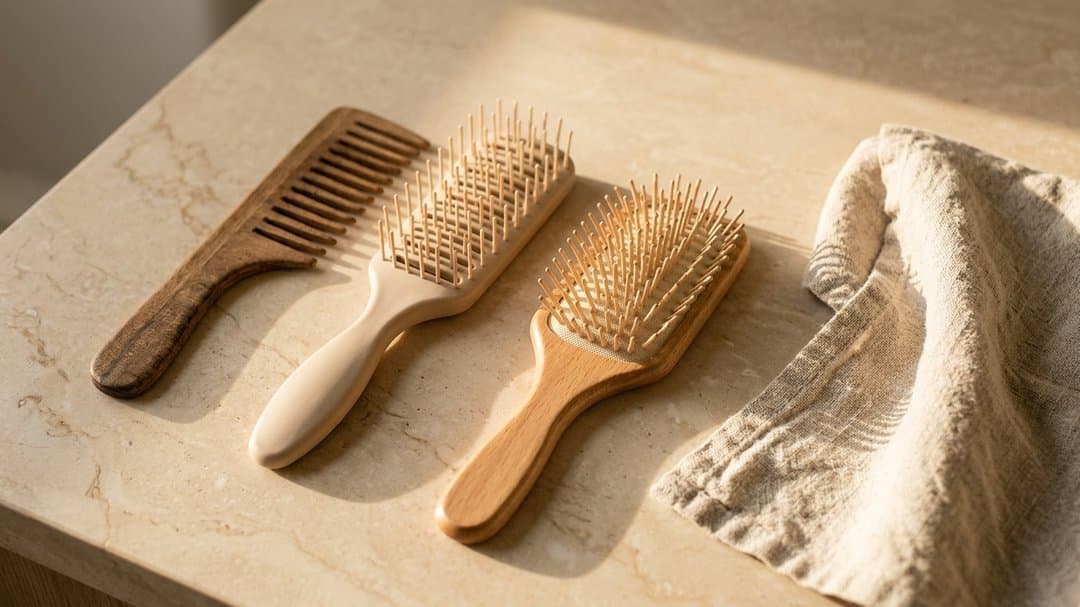
A hairbrush is such an ordinary object that most people never choose one — they use whatever came to hand. Yet it is the brush that decides whether hair comes apart or tears.
Three rules rule out most of the bad ones. The thicker your hair, the wider the teeth should sit; on fine or sparse hair, the opposite holds and a closer set works better. Skip cheap plastic, and metal all the more so; both are hard on the hair and on the scalp. And above all, brushing should feel pleasant. If a brush tugs and snags on knots instead of taking them apart, it isn't your brush, whatever it cost.
Then there are the types. A vented brush, with openings through the body, earns its place when you are blow-drying: hot air passes through instead of breaking against a solid back, so both the brush and the hair under it stay cooler. A solid brush sitting in the airflow heats up and passes that heat on.
A silicone-and-plastic cushion brush has teeth with a little give in them, so they bend and follow the shape of the hair and the whole thing feels gentler. It washes easily and handles dry and wet hair alike.
Natural bristle is the kindest of the lot. The bristles flex against the hair and polish the length as they go, and hair is noticeably smoother afterwards. Two drawbacks: dust collects down among the bristles, and on curls it adds frizz.
Wet brushes are a category of their own, and a necessary one. They take tangles apart without pulling, and they are the right tool for working across the scalp during a wash and for spreading a mask along the length.
The brush itself needs washing. Once a week, pull the hair out with your fingers or an old toothbrush, work up a lather of soap or shampoo, spread it over the brush, leave it five to ten minutes, rinse under hot water and set it bristles-down to dry. Natural bristle wants more care — ten minutes in a bowl of water and shampoo, keeping the soft pad and the wooden base out of the water so they don't swell, then bristles-down again until it is properly dry.
Keep it somewhere free of dust rather than on an open shelf, or it is dirty again within the week.
Replace it when the teeth start bending or catching, or, with natural bristle, when it starts to splay.